Michael Arereng and Stephen Ouma Recall the Day They Witnessed Idi Amin’s Grenade Attack in Kibuli
The Grenade at Kibuli: Michael Arereng and Stephen Ouma Revisit a Childhood Memory of Idi Amin
Founder & Chief Editor · 22 August 2026 · 6 min read
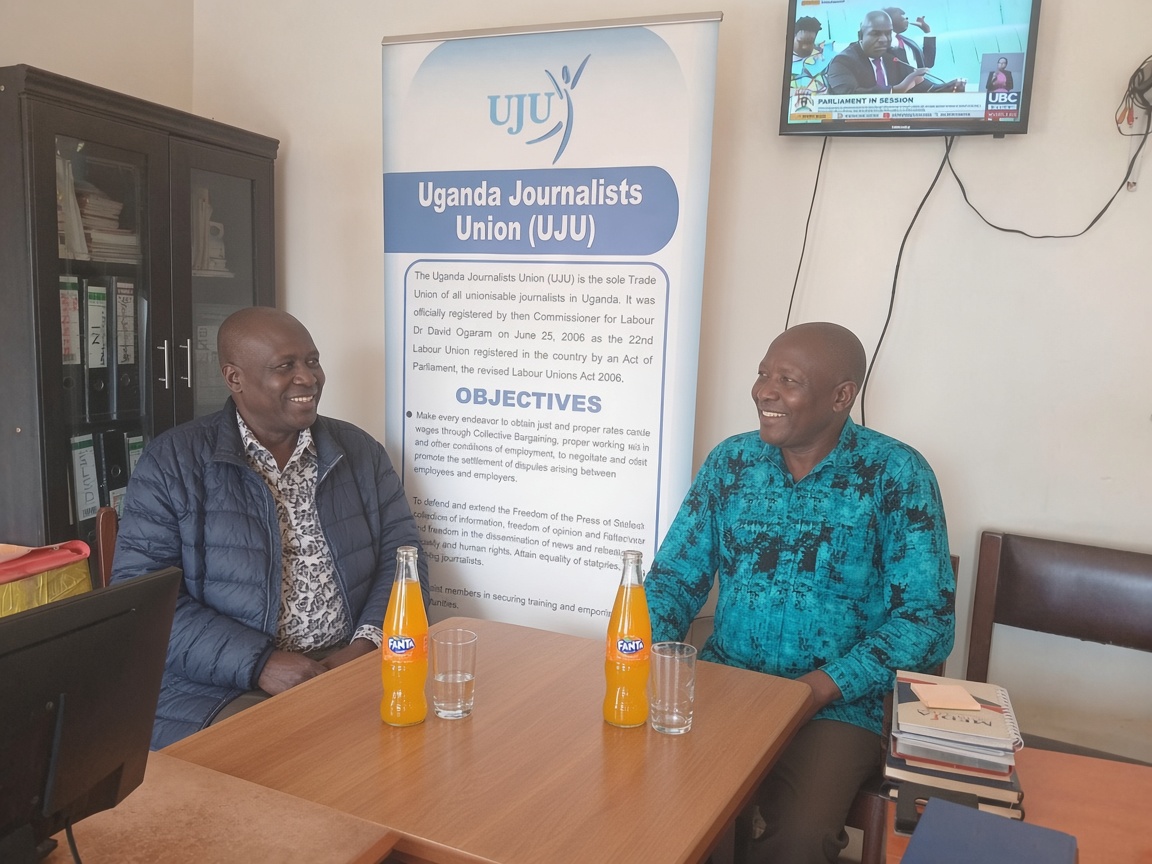
KAMPALA, Uganda — Sometimes history does not need a dusty archive, a thick textbook or a serious-looking documentary narrator. Sometimes it needs two old friends sitting together, laughing, comparing memories and suddenly transporting themselves back in time.
That is exactly what happened when Michael Arereng visited his childhood friend Stephen Ouma at the Uganda Journalists Union (UJU) office. What began as a friendly reunion quickly turned into a vivid journey into their childhood in Kibuli and one of the most frightening days they remember from Uganda’s turbulent past.
The two men were still boys when they witnessed events surrounding a grenade attack on President Idi Amin Dada. Decades later, they recall the incident with remarkable detail and occasional humour — the kind of humour that often accompanies memories carried by people who actually lived through an experience. Listening to them, it sometimes feels less like a historical account and more like two childhood friends reopening a conversation they had only paused yesterday — or, as their vivid recollections suggest, “this morning.”
Arereng remembers that the day began innocently enough, with the boys at the Police Training School in Kibuli playing football and watching activities around the police grounds. They later learnt that Amin would attend a pass-out parade for police officers who had completed their training.
The arrival of the President naturally became a major event for the boys. Politics, however, was not necessarily their biggest concern at the time. Like most children, they were more interested in what they could get from the important visitor. In this case, the answer was sweets. Arereng recalls that they approached Amin and asked for something to eat, after which the President reportedly ordered sweets for them. “We were very happy. Being a child, when they buy you sweets, you become very happy,” he recalls.
For a few moments, the day seemed destined to become one of those happy childhood memories involving football, police uniforms, a presidential appearance and free sweets. But after the ceremony, everything changed dramatically when Amin reportedly decided to drive himself out of the training grounds.
As the vehicle approached the main entrance, a grenade was thrown at it. Arereng recalls that the attackers appeared to have expected Amin to be seated on the left-hand side of the vehicle, yet he was actually driving himself. The grenade missed the President but fatally wounded his driver, whom the witnesses identified as Muhammad Abbas.
For the boys, there was obviously no time to analyse who was sitting where. There had been an explosion, and their immediate instinct was to get as far away from the scene as possible.
Ouma remembers their reaction as essentially “run first, ask questions later.” He recalls them racing towards Mukono with the speed and determination of athletes competing in a 100-metre final.
Nobody had to instruct them to run. Fear had already taken over. The irony was striking: the same boys who had been happily following the President after receiving sweets were, only minutes later, running away from the scene for their lives. Arereng says Amin did not simply abandon the damaged vehicle but continued driving towards Mulago Hospital with his injured driver. “He had no bodyguards behind him, there was no convoy. He just drove,” he recalls.
He adds that one of the vehicle’s tyres had reportedly been damaged, but Amin continued towards the hospital. The driver later died, leaving the boys and residents around Kibuli and Nsambya with another frightening thought: what would happen next? It was Ouma who recalled the fear that soldiers could come after them because the President had been attacked in the area. “When we learnt of that, we thought we were going to be attacked by the soldiers. Our fear was that the President was going to revenge,” he recalls.
The expected retaliation, however, did not immediately come. After one quiet night followed another, they slowly began to realise that perhaps the soldiers were not coming for them. Ouma also remembers the atmosphere around Kibuli and recalls what he describes as a demonstration involving Amin and then-government minister Sabuni.
According to Ouma’s recollection, Amin demonstrated fighting techniques associated with taekwondo by kicking Sabuni before explaining that he was showing how to fight an opponent. But nothing could compete with the grenade incident in their memories. Ouma also recalls fears that security forces could target areas around Kibuli and Nsambya that were believed to harbour opponents of Amin’s government. He remembers Maj. Gen. Mustafa Adrisi bringing two armoured personnel carriers near Kibuli Mosque, further fuelling fears that something serious was about to happen.
For the boys, Amin had already become a larger-than-life figure because they had seen him up close, watched him address police officers and even approached him for sweets. Ouma remembers looking at the President almost like a character from an action movie. “He was a film star,” he recalls — a description that perhaps captures how extraordinary Amin appeared to them when they encountered him directly. The two men said they were not historians watching events from a distance. They were boys standing close enough to see the President, ask him for sweets and watch him drive away, only to hear an explosion moments later.
That is perhaps why the memory has survived so strongly. What they remember is not simply the political significance of the attack, but the strange sequence of childhood experiences: football, sweets, excitement, an explosion, fear and a desperate run to safety.
Why Osmara Digital Media Is Telling This Story There have been many accounts, interpretations and historical narratives surrounding Idi Amin’s years in power and the violence that characterised that period. Osmara Digital Media is featuring this story because Michael Arereng and Stephen Ouma were there.
Their personal recollections offer a different window into Uganda’s troubled history — not through political speeches or official reports, but through the eyes of two boys who experienced a frightening moment without fully understanding its political significance at the time.
The two men have now given their personal recollections to Osmara Digital Media, describing what they saw, heard and feared. Their memories are striking because they do not sound like a rehearsed history lesson. They remember the football, the sweets, the President, the explosion and the frantic running. They recount these details with such confidence and vividness that, while listening to them, one can almost imagine the two childhood friends saying, “It was just this morning.”
Their conversation also reveals another side of history: the way major political events are remembered by ordinary people who experienced them at a young age. For Arereng and Ouma, the story is not simply about Amin, politics, soldiers or a grenade. It is about two boys playing football in Kibuli, receiving sweets from a President and then suddenly discovering that the grown-up world could become dangerous within seconds.
More than four decades later, the two childhood friends can sit together, laugh, compare memories and revisit a frightening chapter of their youth, turning what was once a terrifying experience into a remarkable oral-history conversation.
Their recollections provide Osmara Digital Media with a rare personal glimpse of how one dramatic moment in Uganda’s troubled past looked and felt through the eyes of those who were there.
Editor’s Note: This feature is based on the personal recollections of Michael Arereng and Stephen Ouma. Osmara Digital Media presents their accounts as oral history and personal testimony and does not independently establish every detail of their recollections as historical fact.
Founder & Chief Editor
Founder and Chief Editor of Osmara Digital Media. Journalist and historian telling Africa's stories through an African lens, from West Nile to the continent.
Related stories

FROM THE NEWSROOM TO THE THRONE: UGANDA JOURNALISTS UNION CONGRATULATES HIS MAJESTY OMUKAMA EDWARD RUKIDI NYABONGO I

Dr. Gad Rugaju Calls for Reflection and Renewed Discipline as 2026 Nears Its Close
Kadaga Assures Busoga on University, Jinja-Kampala Expressway