Arua’s One-County Question: Is Vurra’s Political Structure Ready for the Future?
Vurra County covers the entire Arua District and has a population of 158,577 people. As Arua grows, Osmara Digital Media examines how the current political structure works and whether it can continue providing effective representation in the future.
Founder & Chief Editor · 11 August 2026 · 10 min read
By Osmara Digital Media
“When a tree grows, the wise farmer does not wait for its branches to break before giving it room to spread.”
This saying offers a useful way of looking at the political and administrative future of Arua District. As communities grow, populations increase and development needs change, structures created for one period may eventually require fresh examination to ensure that they continue serving the people effectively.
Osmara Digital Media finds it necessary to open that conversation about Arua. Today, the entire Arua District is made up of one parliamentary county — Vurra County — bringing together Vurra, Logiri, Arivu and Ajia sub-counties. The arrangement provides a clear political structure and gives the district a unified parliamentary constituency, while the same population is also represented by the Arua District Woman Member of Parliament.
The issue, therefore, is not whether the current structure is good or bad. The more constructive and important question is whether the structure is ready for the Arua of the future, particularly as the population grows, economic activity expands and communities demand better public services. That is the question Osmara Digital Media is examining.
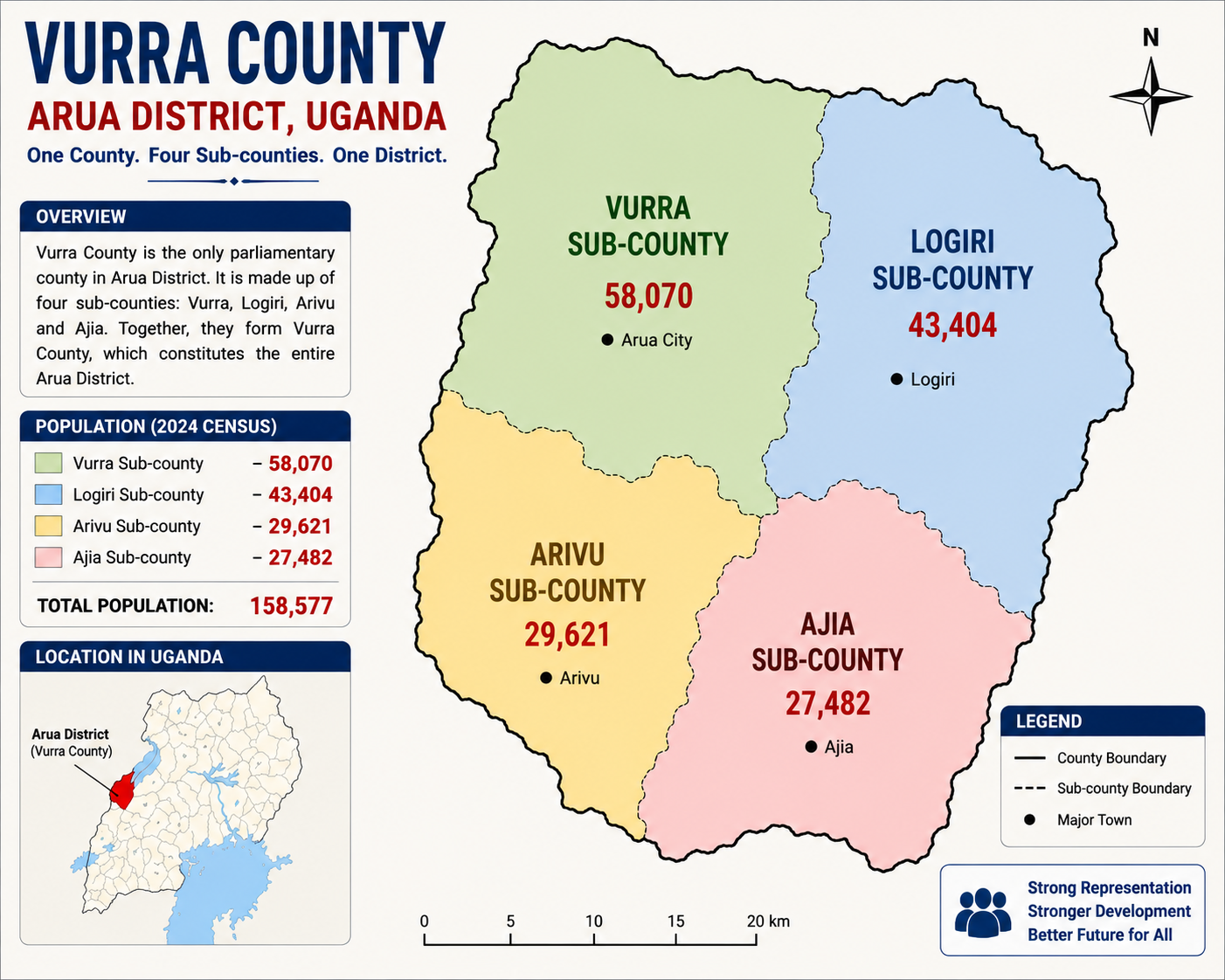
A district built around one parliamentary county Arua District currently has one parliamentary county — Vurra County. The county comprises four sub-counties: Vurra, Logiri, Arivu and Ajia. Together, they form Vurra County, and Vurra County covers the entire geographical area of Arua District.
Residents in these communities directly elected Charity Lenia Kevin as the Member of Parliament for Vurra County. At the same time, the same population is represented by Lillian Obiale Paparu, the Arua District Woman Member of Parliament, whose district-wide mandate covers the same geographical area.
For a resident, this means that the political representation of the community comes through two different parliamentary positions. A voter in Ajia, for example, has a directly elected constituency MP representing Vurra County and also has a district Woman MP representing Arua District. The same applies to residents of Arivu, Logiri and Vurra.
This does not mean that Vurra County has two constituency MPs. The two representatives hold different parliamentary positions and receive their mandates through different elections. Their geographical areas overlap because Vurra County currently constitutes the entire Arua District.
Understanding this distinction is important because it provides the foundation for examining whether the existing arrangement can continue to serve Arua effectively as the district develops.
The population behind the conversation The discussion becomes particularly important when the population of Vurra County is considered.
According to the 2024 National Population and Housing Census, Vurra County has a population of 158,577 people. The census records 58,070 residents in Vurra Sub-county, 43,404 in Logiri, 29,621 in Arivu and 27,482 in Ajia. Together, these communities form a substantial population under one parliamentary county. That population is not simply a number on a census document. Behind the figure are families, farmers, traders, teachers, health workers, young people, businesses and communities seeking opportunities and better public services. They require good roads connecting communities and markets. They need functioning health facilities, quality education, access to clean water and support for agriculture and businesses. Young people need skills and employment opportunities, while communities need effective representation when engaging government over development priorities.
As these needs increase, the importance of effective political representation also increases. This is why the population figure provides a legitimate starting point for a conversation about the future of Arua’s political structure. Could Arua’s current arrangement become an advantage?
The fact that the entire district is represented through one parliamentary county does not necessarily have to be viewed negatively. In fact, it can offer an opportunity. A single constituency covering the entire district can provide a unified parliamentary voice for communities across Vurra, Logiri, Arivu and Ajia. At the same time, the presence of the Arua District Woman MP gives residents another parliamentary voice operating within the same geographical area through a different mandate.
If the two representatives coordinate their work effectively, this arrangement could strengthen Arua’s ability to advocate for development. Instead of communities speaking through competing political centres, the two parliamentary offices could work together on issues that affect the entire district. Road infrastructure, education, health, agriculture, water, youth empowerment and economic development are not issues that belong to one political camp. They affect the entire population.
A strong working relationship between the two parliamentary offices could therefore turn overlapping representation into an opportunity for stronger advocacy. Where clarity becomes important At the same time, an effective political structure requires residents to understand how representation works. Because the two MPs operate within the same geographical area, voters may reasonably want to know how their responsibilities differ and how the two offices can complement each other. A community that needs government intervention on a major road project, for example, should be able to understand how its constituency MP can raise the matter and how the district Woman MP can also support broader district-level advocacy. The same applies to health facilities, schools, agricultural programmes, youth initiatives and other government services. The important issue is therefore not competition between the two offices. It is coordination.
If residents understand the different mandates and the two representatives work together where appropriate, the arrangement can potentially give Arua a stronger voice. Is the population large enough to begin thinking about the future? The population of 158,577 naturally invites a broader conversation about the future. This does not mean that population size alone should automatically result in the creation of another parliamentary constituency. Any future review of parliamentary boundaries would need to consider several factors, including population distribution, geographical size, accessibility, existing administrative units, settlement patterns and the ability to provide effective representation and public services.
However, the growing population does provide a reason for Arua to begin thinking ahead. Rather than waiting until communities become difficult to administer or political representation becomes overstretched, leaders and residents can examine the evidence early and determine whether the existing structure is likely to remain appropriate. The discussion can therefore be viewed as an exercise in planning rather than a demand for political expansion.
What does effective representation actually mean? The most important part of the debate may not be the number of constituencies. It is the quality of representation. If two parliamentary representatives serve the same geographical population through different mandates, residents should be able to see how both offices are contributing to the district. Are the two representatives regularly identifying the most important development challenges facing Vurra, Logiri, Arivu and Ajia and presenting those concerns effectively before government? Are they working together where district-wide issues require a coordinated parliamentary approach, while still maintaining their separate mandates? Are communities receiving adequate information about the work being done by their elected representatives and the responsibilities attached to each parliamentary position? Are major issues affecting roads, schools, health centres, agriculture, water, youth employment and local economic development being consistently followed up? And, ultimately, can residents point to tangible improvements and say that their political representation has helped bring government services and development closer to them?
These questions are not meant to undermine elected leaders. They are part of the normal democratic process through which citizens assess whether their institutions are working effectively. Arua is changing rapidly Arua today is not the same as Arua of the past.
Arua City has become one of the major commercial centres in West Nile, while surrounding rural communities continue to grow and develop stronger economic links with the city. Markets are expanding. Population is increasing. Transport networks are becoming more important. Young people are seeking employment and business opportunities, while farmers need better access to markets and agricultural support.
These changes inevitably place new demands on public institutions. Political representation must therefore be considered alongside broader questions of planning and service delivery. As settlements expand and population patterns change, it may become necessary in the future to review how communities are grouped for political and administrative purposes. That does not mean that the current structure has failed. It means that successful institutions must be capable of adapting when circumstances change. The 2024 census gives Arua an opportunity The latest population census gives Arua something important: reliable data from which future discussions can begin. With Vurra County recorded at 158,577 people, leaders and planners have an opportunity to examine how the population is distributed across the four sub-counties and how that distribution could change in the coming years. The conversation could look at whether population growth is occurring evenly or whether some areas are expanding faster than others. It could examine how easily residents can access government services and whether geographical distances create challenges. It could also consider how Arua City’s growth is influencing surrounding communities and whether the existing administrative boundaries remain practical as urban and rural areas become increasingly interconnected. Such an assessment would provide a stronger basis for future decisions than political arguments alone. Should Arua begin planning before the pressure increases? A responsible district does not necessarily wait for a crisis before examining its future. Arua can begin the conversation now while the current system is functioning.
Leaders, residents, civil society organisations, local government officials and other stakeholders can examine the population data, development trends and service delivery needs and ask whether the current structure is likely to remain effective over the long term. If the evidence shows that one parliamentary county continues to provide effective representation, then the existing arrangement can be strengthened.
If future evidence demonstrates that changing population patterns or administrative realities require a review, Arua will already have a strong factual basis for that discussion. Either outcome would be better than allowing political boundaries to become a subject of speculation without evidence.
The future should be about people, not positions Any conversation about parliamentary boundaries must remain focused on the interests of citizens. Creating another constituency would mean creating another parliamentary seat, but the objective should never simply be to create more political positions.
The real question should always be whether a change would improve representation and ultimately contribute to better governance and service delivery. A new constituency should only be considered if evidence shows that it would make representation more effective and bring government closer to communities.
Likewise, maintaining the existing structure should not be seen as a failure if it continues to provide effective representation. The principle should be simple: political structures should serve people, not the other way around. A positive opportunity for Arua The discussion about Vurra County therefore presents Arua with an opportunity rather than a problem. The district can use its population growth and changing development environment to assess what is working, identify areas that need improvement and plan for the future. The presence of two parliamentary representatives within the same geographical population can also become a strength if the offices maintain clear mandates and work together on issues affecting the entire district.
Residents, meanwhile, can play their part by demanding information, participating in public discussions and holding their elected representatives accountable for the commitments they make. Arua does not need political confrontation to discuss its future. It needs facts, dialogue and forward-looking leadership. The question Arua should keep asking For now, Vurra County remains the only parliamentary county in Arua District.
Its four sub-counties — Vurra, Logiri, Arivu and Ajia — are home to a population of 158,577 people, according to the 2024 census. Those residents have a directly elected constituency MP and a district Woman MP whose geographical mandate covers the same communities through a different parliamentary position.
The arrangement can work effectively if representation is clear, leadership is accountable and the two parliamentary voices use their respective mandates to advance the interests of the people. But as Arua grows, it is reasonable for residents and leaders to keep examining whether the structure remains fit for purpose. The most important question is therefore not whether Arua needs more politicians.
It is whether the political structure it has today will continue to provide effective representation as the district’s population, economy and development needs expand. Arua has an opportunity to answer that question through evidence, consultation and careful planning rather than political rivalry. And perhaps that is the most important lesson from the old saying: when a tree grows, wise people do not wait for its branches to break before deciding whether it needs more room. For Arua, the time to think about the future of Vurra’s political structure is not when the system becomes overwhelmed. The time to examine it is while there is still an opportunity to plan wisely.
Founder & Chief Editor
Founder and Chief Editor of Osmara Digital Media. Journalist and historian telling Africa's stories through an African lens, from West Nile to the continent.
Related stories
THE MAN UGANDA FORGOT: ALEX YAFFESI LOBIDRA — WHY IS HIS NAME MISSING FROM HISTORY?
West Nile Districts Showcase Talent and Unity Through Football Tournament in South Sudan
Koboko Cocoa Cooperative Brings West Nile Farmers Together for Three-Day Training