Traveller’s Dispatch: Walking Jinja’s Main Street – Where History Still Hums
A nostalgic walk through Jinja’s Main Street becomes a journey through childhood memories, historic architecture and a city that continues to evolve without losing its connection to the past.

Founder & Chief Editor · 6 September 2026 · 9 min read
JINJA CITY, UGANDA — Walking through Jinja’s Main Street today takes me back to a different period of my life, a time when I knew these streets not as a traveller, journalist or observer, but simply as a child growing up in the city. Every time I return to this part of Jinja, I find myself reconnecting with memories that have remained with me for years, because these were the streets where we walked, played, laughed, met friends and moved through the city without ever imagining that one day those ordinary moments would become some of the memories I would treasure most.
As a child, I never looked at Main Street with the eyes I have today. The old buildings, historic shops and architectural details that now attract my attention were simply part of the environment in which we lived. We could walk through the heart of the city without stopping to ask ourselves when a building had been constructed, who had occupied it before us or what role it had played in the development of Jinja. Our minds were occupied by childhood games, friendships and the excitement of being out in the city, and the streets seemed to belong to us in the innocent way children often feel that familiar places are their own.
I still remember how we used to walk through Main Street and the surrounding areas, sometimes with a particular destination and sometimes simply because walking through the town was part of our daily lives. We would move from one place to another, play along the way and meet other children, while the adults around us went about their businesses. The street was already busy, but we knew how to navigate it, recognising familiar shops, faces and corners without giving much thought to the fact that we were growing up in one of Uganda’s historically important urban centres.
Returning to Main Street now, I realise how much I failed to notice when I was young. The buildings that once appeared ordinary to me now carry an architectural character that tells part of Jinja’s story. Two-storey colonial-era structures with arched verandas stand alongside older commercial buildings, pastel-coloured façades and structures reflecting the influence of the Asian trading community that became deeply involved in the development of Jinja’s commercial life. Their weathered walls, ornate balconies, large windows and ageing shopfronts offer glimpses of another era, particularly the decades when Jinja was developing into an important commercial and industrial centre.
As I walk, I sometimes find myself wondering about the generations of people who passed through these same streets before my childhood and before the modern city took shape. Indian merchants and British administrators played significant roles in the development of Jinja, and traces of that history remain visible in the buildings and institutions that have survived the passage of time. What fascinates me now is that, as a child, I was walking through this history without understanding it, because the past was not presented to me as something distant or preserved behind glass; it was simply part of the environment in which I lived.
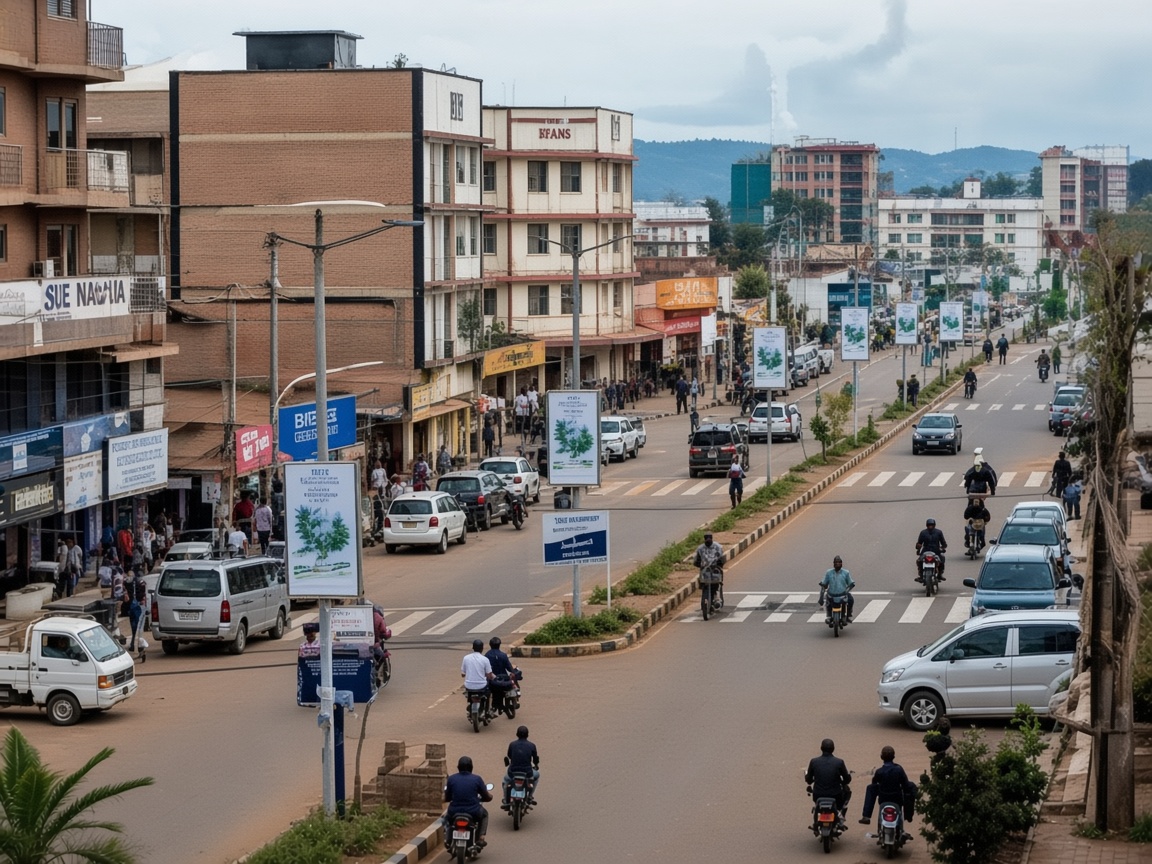
Main Street has changed considerably since those childhood days, but it has not lost the energy that made it familiar to me. Today, matatus, boda-bodas, private cars and delivery vehicles compete for space along the busy road, while pedestrians move between shops and businesses that cater to almost every aspect of daily life. Hardware shops, electronics dealers, clothing stores, fabric shops, restaurants, mobile-money outlets and other businesses keep the street active from morning until evening, creating a commercial rhythm that connects the historic character of Jinja with the demands of a modern city.
There is something particularly fascinating about seeing an old building carrying a new business sign, because it reminds me that cities are constantly changing even when their physical foundations remain. A structure that may once have housed an established trading enterprise can now accommodate a modern shop, office or service provider, while a new multi-storey building may stand directly beside an older structure whose walls have witnessed several generations of commercial activity. To me, this mixture of old and new is one of the things that gives Jinja its distinctive character, because the city has continued to develop without completely erasing the evidence of where it came from.
The historic landmarks around the city centre add another layer to the experience, particularly the old Post Office, the police station dating from 1928 and the Madhvani Building, which is associated with the early twentieth-century commercial history of Jinja. The presence of such buildings reminds me that the streets I once regarded simply as places to walk and play were already carrying stories about trade, administration, migration, industry and the growth of urban Uganda long before I was born.
The Madhvani story is particularly significant when considering Jinja’s commercial and industrial history, given the important role played by Indian-origin entrepreneurs in the development of businesses and industries in the area. For a traveller, these buildings can be viewed as heritage sites, but for someone who grew up in Jinja, they also form part of a familiar landscape that was woven into everyday life long before I began looking at the city through the lens of history and travel. One of the things I appreciate most when walking through Main Street today is the way ordinary life continues around these reminders of the past. Traders are negotiating with customers, boda-boda riders are waiting for passengers, office workers are moving between appointments and pedestrians are crossing the street as they pursue their daily activities. The sound of engines, conversations, music from shops and occasional vehicle horns creates the unmistakable soundtrack of a busy Ugandan city, and beneath all that noise I can still recognise something of the atmosphere I remember from my childhood.
The difference is that I now walk more slowly and observe more carefully. When I was young, I rarely looked up at the buildings or thought about the stories contained within their walls, whereas today I find myself examining balconies, windows, faded paint, old shopfronts and architectural details that I once passed without a second thought. Age has changed the way I see the city, and perhaps travelling and journalism have also taught me to appreciate the details that childhood innocence allowed me to overlook.
As the afternoon light begins to soften the buildings, the atmosphere of Main Street changes slightly, although the movement of people and vehicles continues. The sunlight falls across old façades while traders remain behind their counters and boda-boda riders continue looking for passengers, and for a moment I find myself comparing the Jinja of today with the city I remember from years ago. The buildings may have changed, businesses may have changed and the volume of traffic may have increased, but the essential character of the street remains rooted in the same combination of commerce, movement and human interaction.
For many visitors, Jinja is defined by the Nile, adventure tourism, rafting, kayaking, boat trips and the famous attraction associated with the source of the great river. Those experiences are undoubtedly part of what makes Jinja attractive to travellers, but walking through Main Street reminds me that there is another side of the city that deserves equal attention. There is a Jinja that exists in its streets, historic buildings, markets, shops, restaurants, neighbourhoods and the everyday lives of the people who have continued to make the city their home.
For me, therefore, walking through Main Street is not simply a travel experience but a personal journey into my own past. I am not discovering the city for the first time, because I knew it long before I understood what it meant to be a historic and culturally significant destination. Instead, I am rediscovering a familiar place with older and more experienced eyes, and that process has made me appreciate how much of our history is hidden in the ordinary places we pass every day.
I sometimes think about the child I was when I walked these streets, unaware that the places where we played would one day become part of my personal history. At that age, we were not thinking about heritage conservation, tourism or urban development; we were simply enjoying the freedom of moving through a city that felt familiar to us. We did not know that the buildings surrounding our childhood would survive long enough for us to return years later and see them as reminders of a past that had shaped the city. That is why returning to Main Street feels different now. The city has changed, and I have changed with it, but the memories have remained remarkably clear, and sometimes a familiar building, street corner or sound is enough to take me back to those childhood days when life seemed much simpler and the streets of Jinja were simply the places where we spent our time.
Jinja’s Main Street therefore offers me more than an opportunity to observe a busy commercial centre or admire old architecture. It gives me a chance to reconnect with the city that shaped part of my childhood and to reflect on how places can remain physically present even as the people who knew them in earlier times grow older and the city around them continues to transform.
For a traveller who is willing to slow down and walk rather than simply drive through Jinja, Main Street offers an experience that goes beyond the conventional tourist itinerary. The street reveals a city where history and modern life continue to exist side by side, where old buildings have been absorbed into contemporary commerce and where generations of residents have left their footprints without necessarily realising that they were contributing to the story of the city.
For me, however, the meaning goes deeper because every walk through Main Street is also a walk through memory. I see the modern city, but somewhere within it I can still see the Jinja of my childhood, the streets we walked through, the places where we played and the familiar surroundings that once seemed so ordinary. The city has continued moving forward, but those memories remain woven into its streets, and perhaps that is why Jinja’s Main Street still feels like home whenever I return.
Walking through it today, I no longer see only buildings, shops and traffic; I see time itself, preserved in fragments of architecture, in the faces of people going about their daily lives and in the memories that continue to connect me to the city where I grew up. Main Street has changed, just as I have changed, but beneath the modern signs, busy traffic and expanding businesses, I can still hear the quiet hum of the Jinja I knew as a child.
Founder & Chief Editor
Founder and Chief Editor of Osmara Digital Media. Journalist and historian telling Africa's stories through an African lens, from West Nile to the continent.
Related stories

KYABAZINGA MOBILISES BUSOGA LEADERS TO TACKLE TEENAGE PREGNANCY AND POVERTY

Kenya President Ruto Announces Plan to Scrap 25% Mobile Phone Import Duty
Hope for 65 Cancer Patients as Kyabirwa Offers Free Procedures