Tayebwa Highlights Uganda’s Progress on Women’s Representation at Mongolia Forum
Uganda’s Deputy Speaker Thomas Tayebwa has highlighted women’s growing representation in Parliament and Cabinet at the World Women Parliamentarians Forum in Mongolia, calling for greater influence in policymaking and decision-making.
Founder & Chief Editor · 12 October 2026 · 3 min read
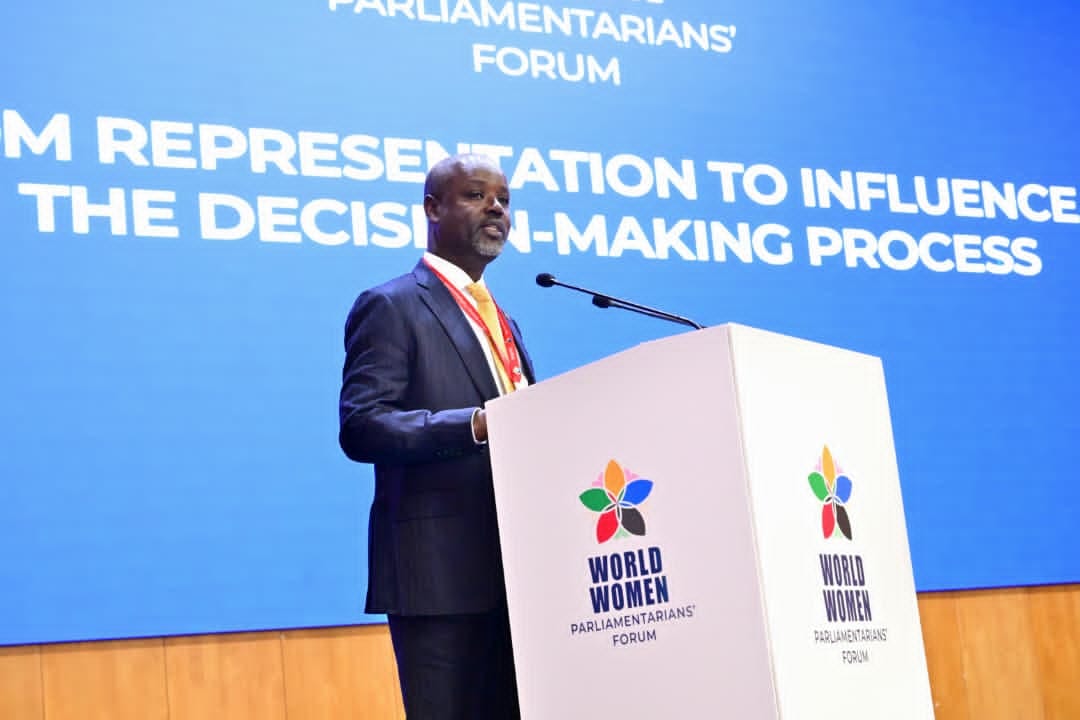
Ulaanbaatar, Mongolia — October 12, 2026: Deputy Speaker of Parliament Thomas Tayebwa has highlighted Uganda’s progress in advancing women’s representation in Parliament and Cabinet, while calling for greater influence of women in policymaking and national decision-making.
Tayebwa made the remarks on Monday while leading Uganda’s delegation at the World Women Parliamentarians Forum in Ulaanbaatar, Mongolia, held on October 12–13 under the theme “From Representation to Influence in the Decision-Making Process.”
He said Uganda had taken deliberate steps to increase women’s participation in governance since 1986, when the National Resistance Movement (NRM) government came to power. These measures include affirmative action, which is enshrined in the Constitution.
According to figures presented by Tayebwa, women account for 35 per cent of Uganda’s Parliament, with 187 women among 529 members, while they constitute 49 per cent of Cabinet.
He cited the positions of Vice President, Prime Minister and two Deputy Prime Ministers as further evidence of women’s participation in senior government leadership.
Tayebwa also highlighted gender and equality assessments in the budgeting process, supported by the Equal Opportunities Commission, as measures intended to ensure that women and other disadvantaged groups benefit from government programmes.
However, he emphasised that representation alone was insufficient, urging countries to strengthen women’s participation in shaping laws, policies, budgets and decisions that affect citizens.
“Representation is only the beginning. Having women in Parliament is important, but the most important measure of progress is whether women are able to influence the laws, the policies, the budgets and decisions that shape the lives of our people,” Tayebwa said.
He described the forum as an important platform for parliamentarians to exchange experiences and identify practical ways of strengthening women’s influence at national, regional and international levels.
“As parliamentarians, we have a responsibility to ensure that women's voices are reflected not only in our chambers, but also in the decisions that determine the future of our societies,” he added.
Uganda’s delegation included Lira District Woman MP Auma Linda Agnes, National Female MP for Persons with Disabilities Laura Kanushu, Wakiso District Woman MP Betty Ethel Naluyima, Soroti District Woman MP Anna Ebaju Adeke and National Female Youth MP Mercy Kanyesigye.
Kenya Calls for Greater Women’s Influence
Leah Sopiato Sankaire, the Kajiado County Woman Representative who led Kenya’s delegation, said the country had made progress in women’s representation but had yet to implement the constitutional requirement that no more than two-thirds of members of any elective or appointive public body should be of the same gender.
Sankaire said Kenya’s Parliament was 31 women representatives short of meeting the required threshold. She noted that efforts to address the shortfall included a constitutional amendment bill.
She argued that women’s influence could be strengthened by ensuring they lead parliamentary committees responsible for allocating public funds.
“When these committees are chaired by women, a gender-sensitive budget becomes a reality,” she said.
Azerbaijan and Mongolia Share Perspectives
Parvana Valiyeva, who led Azerbaijan’s delegation, highlighted her country’s historical contribution to women’s rights, noting that Azerbaijan became the first country in the Muslim East to grant women the right to vote and stand for election in 1918. She also cited the establishment of the first secular school for women in the Muslim East in Azerbaijan in 1901.
Valiyeva urged women parliamentarians to ensure that women’s voices were heard in key areas shaping the world, including climate change, technology, economic development, peace and security.
Mongolia’s Minister of Foreign Affairs, Battsetseg Batmunkh, credited women’s sustained advocacy for progress in implementing the declaration adopted at the 1995 World Conference on Women in Beijing.
“Since the conference, the representation of women in parliament has more than doubled,” she said, adding that many achievements celebrated today were made possible by women who refused to accept limitations imposed on them.
The forum provides a platform for women parliamentarians to share experiences and discuss strategies for translating increased representation into meaningful influence over public policy and governance.
Founder & Chief Editor
Founder and Chief Editor of Osmara Digital Media. Journalist and historian telling Africa's stories through an African lens, from West Nile to the continent.
Related stories
AU Supports Seychelles’ First National Action Plan on Women, Peace and Security
Minister Namuganza Declares Herself PLU Founder, Throws Weight Behind Muhoozi Presidency Bid
PRESIDENT MUSEVENI COMMISSIONS $53M MILITARY FACILITY, DEEPENS UGANDA-RUSSIA DEFENCE COOPERATION