Africa’s Next Tourism Boom: 10 Destinations Ready to Compete With the World
From Uganda’s wildlife to Tanzania’s safaris, Rwanda’s gorillas and Morocco’s historic cities, Africa’s tourism industry is entering a new era of growth, investment and global opportunity.

Founder & Chief Editor · 7 August 2026 · 7 min read
By Draga Osman Brahan
Kampala-Uganda: Africa has some of the world's most extraordinary tourism assets — from vast savannahs and tropical forests to mountains, beaches, deserts, ancient cities and diverse cultures.
Yet the continent still captures only a fraction of global tourism compared with regions such as Europe, Asia and the Americas.
That gap represents an enormous opportunity.
As airlines expand routes, roads and airports improve, hotels and lodges increase and African countries market their destinations more aggressively, a new tourism map is emerging.
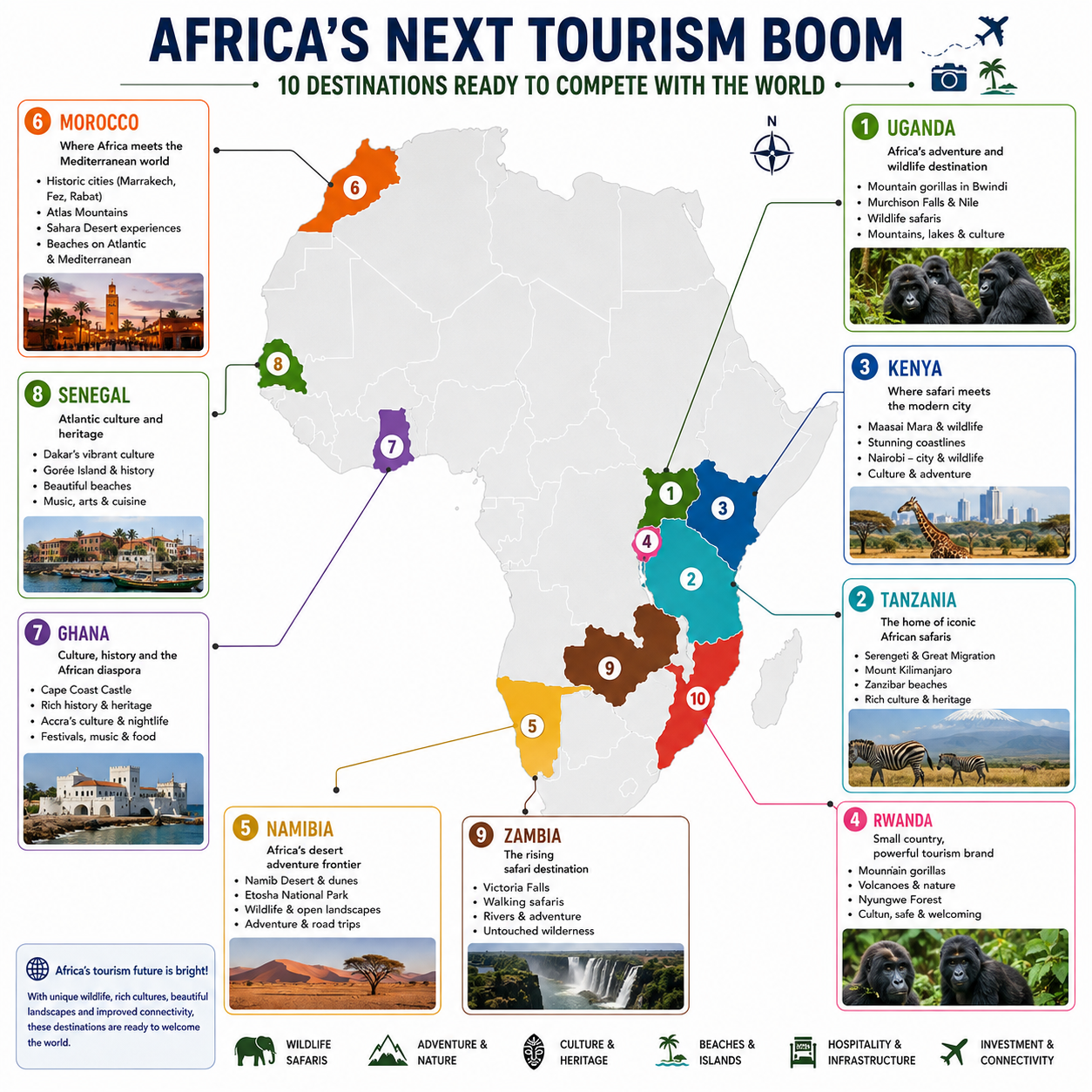
Here are 10 African destinations with the potential to compete more strongly on the global tourism stage.
- Uganda: Africa’s adventure and wildlife destination
Uganda could become one of Africa's most exciting tourism destinations as it combines wildlife, mountains, forests, lakes, rivers and cultural experiences within one country.
The country's biggest tourism attraction is its wildlife. Uganda is home to mountain gorillas in Bwindi Impenetrable National Park and chimpanzees in several forest destinations.
But Uganda's tourism story extends far beyond gorillas.
Murchison Falls National Park offers dramatic landscapes and wildlife safaris, while Queen Elizabeth National Park is known for its diverse wildlife and the famous tree-climbing lions of Ishasha.
The Rwenzori Mountains provide opportunities for mountaineering and adventure tourism, while the Nile offers rafting and other water-based activities.
Uganda's lakes, including Lake Victoria, cultural heritage and growing hospitality sector add further possibilities.
The opportunity is to package these attractions into longer visitor experiences rather than marketing individual destinations separately.
With better roads, airport connectivity, tourism infrastructure and international marketing, Uganda could strengthen its position as one of Africa's leading adventure and nature destinations.
- Tanzania: The home of iconic African safaris
Tanzania already possesses one of Africa's strongest tourism brands.
The Serengeti, Mount Kilimanjaro and Zanzibar give the country a powerful combination of wildlife, adventure and beach tourism.
The annual movement of wildebeest across the Serengeti has become one of the world's most recognisable wildlife spectacles.
Mount Kilimanjaro attracts climbers from around the world, while Zanzibar provides a complementary Indian Ocean experience.
Tanzania's opportunity is to continue expanding beyond its established attractions by strengthening cultural tourism, community-based tourism, marine tourism and lesser-known destinations.
- Kenya: Where safari meets the modern city
Kenya has long been one of Africa's most recognised tourism destinations.
The Maasai Mara, Amboseli and Tsavo provide world-class safari experiences, while the Kenyan coast offers beaches, history and Swahili culture.
Nairobi provides something different: a major African city with business, food, culture and wildlife experiences.
Kenya's tourism strength comes from this diversity.
The country can attract visitors seeking traditional safaris while also developing conference tourism, adventure travel, sports tourism, coastal experiences and cultural tourism.
- Rwanda: Small country, powerful tourism brand
Rwanda has built an increasingly strong international tourism reputation around conservation, mountain gorillas, clean urban environments and high-quality visitor experiences.
Volcanoes National Park remains the country's flagship attraction because of its mountain gorillas.
But Rwanda's tourism offering also includes Akagera National Park, Nyungwe Forest and the rapidly developing hospitality and conference sectors.
Kigali has also positioned itself as a destination for international conferences and business events.
Rwanda's experience demonstrates how a relatively small country can build a powerful tourism brand through conservation, infrastructure and focused international marketing.
- Namibia: Africa’s desert adventure frontier
Namibia offers a tourism experience that is dramatically different from the tropical landscapes associated with much of Africa.
Its vast deserts, dramatic dunes, wildlife and open landscapes make it particularly attractive to adventure travellers and photographers.
The Namib Desert and Etosha National Park are among its best-known attractions.
Namibia also offers opportunities for community-based conservation and wildlife tourism.
Its relatively low population density gives visitors a sense of space that is increasingly valuable in the global tourism market.
- Morocco: Where Africa meets the Arab and Mediterranean worlds
Morocco has one of the most diversified tourism offerings on the continent.
Marrakech, Fez and other historic cities provide architecture, markets, cuisine and cultural experiences, while the Atlas Mountains offer adventure tourism.
The country's Atlantic and Mediterranean coastlines provide beach tourism, while the Sahara offers desert experiences.
Morocco's geographical position also makes it highly accessible to European travellers.
Its ability to combine history, culture, food, beaches and adventure gives it a competitive advantage in attracting different categories of international visitors.
- Ghana: Culture, history and the African diaspora
Ghana is emerging as one of West Africa's most important cultural tourism destinations.
Its castles and forts along the coast connect visitors to the history of the transatlantic slave trade, while Accra offers contemporary African culture, music, fashion, food and nightlife.
The country has also attracted growing interest from the African diaspora.
Ghana's opportunity is to combine historical tourism with modern cultural experiences and nature-based destinations to encourage visitors to stay longer and explore beyond Accra.
- Senegal: Atlantic culture and heritage
Senegal offers a distinctive combination of history, culture, beaches and urban experiences.
Dakar is a major cultural centre, while destinations such as Gorée Island provide important historical experiences.
The country's music, cuisine, arts and coastal landscapes add to its tourism appeal.
Senegal could strengthen its position as a gateway to West African cultural tourism by improving regional connectivity and packaging its heritage and coastal attractions for international travellers.
- Zambia: The rising safari destination
Zambia is increasingly attracting attention among travellers looking for less crowded wildlife experiences.
Victoria Falls, shared with neighbouring Zimbabwe, is one of Africa's most spectacular natural attractions.
Beyond the falls, Zambia offers national parks, rivers, walking safaris and opportunities for close encounters with wildlife.
Its tourism model has the potential to appeal particularly to visitors seeking wilderness and adventure away from heavily commercialised destinations.
- Mozambique: Beaches, islands and the Indian Ocean
Mozambique possesses a long Indian Ocean coastline, tropical islands and rich marine ecosystems.
Its beaches and diving opportunities provide a foundation for a major coastal tourism industry.
Destinations such as the Bazaruto Archipelago offer luxury, marine and nature-based tourism, while the country's cultural heritage provides another layer to the visitor experience.
Mozambique's long-term tourism opportunity will depend on continued investment in infrastructure, connectivity, conservation and local communities.
The next tourism race will be about more than wildlife
Africa's tourism future cannot depend entirely on traditional safari tourism.
The next generation of travellers is looking for experiences.
They want to climb mountains, explore cities, experience African cuisine, discover cultures, visit historic sites, enjoy beaches, attend festivals, see wildlife and connect with local communities.
This creates opportunities for countries to develop multi-experience tourism.
Uganda, for example, can combine gorilla trekking with Nile adventures, mountain climbing, cultural tourism and wildlife safaris.
Tanzania can combine the Serengeti and Kilimanjaro with Zanzibar.
Kenya can connect safari tourism with the coast and Nairobi.
Morocco can combine historic cities with the Atlas Mountains and Sahara.
Rwanda can combine gorilla tourism with wildlife, forests and conferences.
Aviation will be critical
Tourism cannot grow without connectivity.
More direct international flights, stronger national airlines, better airports and easier regional connections could significantly change Africa's tourism industry.
For countries such as Uganda, improved air connectivity can make the difference between being an attractive destination on paper and becoming a destination tourists can easily reach.
Regional tourism could also become increasingly important.
An international visitor could potentially experience several African countries during one trip if borders, flights, roads and tourism packages become more integrated.
Tourism can create jobs beyond hotels
The economic impact of tourism extends far beyond hotels and national parks.
Tourism creates opportunities for guides, drivers, farmers, artists, photographers, restaurants, transport companies, craftspeople, conservationists and small businesses.
This makes tourism particularly important for young Africans seeking employment and entrepreneurship opportunities.
The challenge is ensuring that local communities receive a meaningful share of tourism revenues.
Africa already has the attractions.
The next challenge is turning those attractions into competitive tourism products.
That requires investment in infrastructure, conservation, marketing, hospitality, aviation, digital technology and human capital.
For Uganda, the opportunity is enormous.
The country does not need to compete with Tanzania or Kenya by copying their tourism models. Instead, it can build its own identity around gorillas, adventure, the Nile, mountains, wildlife, culture and authentic African experiences.
Across the continent, the same principle applies.
The next tourism powerhouses will be the countries that combine their natural and cultural assets with world-class visitor experiences.
Africa's tourism boom may therefore not be a single story.
It could be the rise of many destinations — each offering a different reason for the world to visit Africa.
Founder & Chief Editor
Founder and Chief Editor of Osmara Digital Media. Journalist and historian telling Africa's stories through an African lens, from West Nile to the continent.